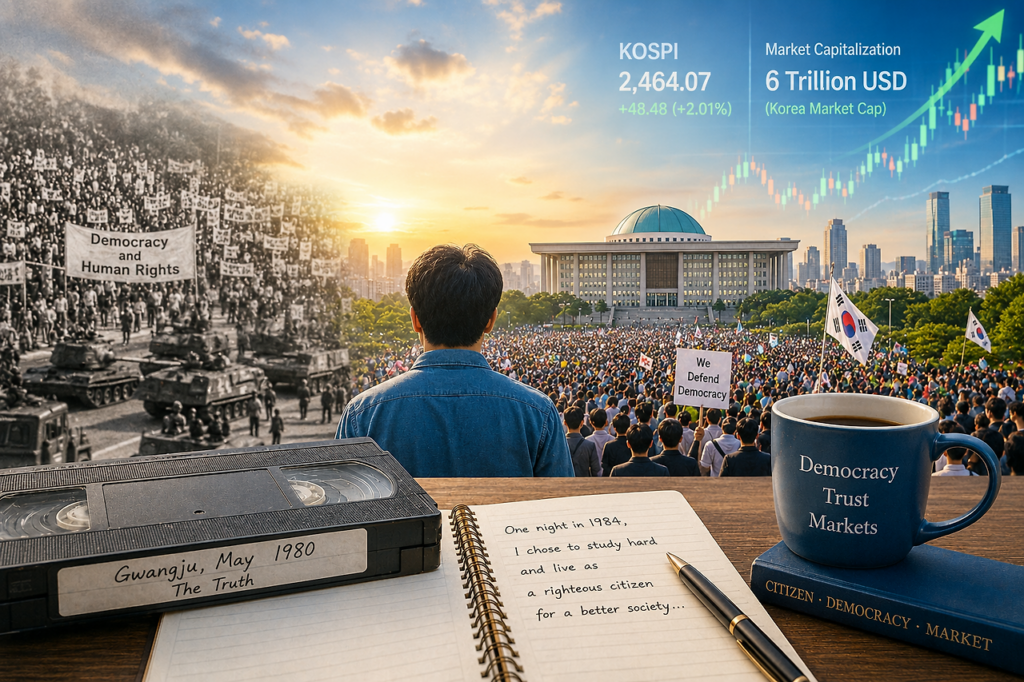
I still remember a night in 1984, shortly after returning to university from my military service. On a worn-out videotape flickering with static, I witnessed the truth of the 1980 Gwangju Uprising—a pivotal pro-democracy movement brutally suppressed by the military regime. The images were raw, and the screams of grief cut deep. For a young reserve soldier who had only just left the military, the shock was beyond words.
Watching fellow students march bravely into the streets, I often reproached myself for not joining them. I wrestled with the guilt of being what was then called a “gray outsider”. During those days of searching, I read Kang Sok-kyong’s novel, A Room in the Woods, questioning where I truly belonged. In the end, I reached a quiet conclusion: if I could not stand at the front lines now, I would devote myself to my studies and later live as an upright, principled citizen.
Decades passed. On the night of December 3, 2024, following the sudden declaration of emergency martial law, I once again found myself awake in front of a television screen. For a generation that grew up watching democracy earned through sacrifice, the news of martial law carried the weight of historical trauma. Memories of May 18 flashed through my mind, and I feared that history itself might move backward.
Yet, what I witnessed on the screen was extraordinary. Citizens stood unarmed before armored vehicles. Ordinary people defended democracy without surrendering to fear. Young soldiers, in the end, refused to fully turn their weapons toward the public. Watching them, I realized how deeply rooted democracy had become in Korea.
And the markets, too, seemed to respond to that trust.
The rise in market capitalization was driven by many economic forces, yet it became impossible to deny that confidence in Korea’s democratic resilience formed the bedrock of that growth. As an investor, I found myself returning to a long-held conviction:
“A history of determined civic struggle strengthens democracy, and a strong democracy ultimately becomes the most reliable foundation for a safe and trustworthy market.”
The young man who once sat before a noisy videotape in 1984, struggling to find his place in history, has now become an investor trying to understand the world and participate in its markets. The market we face today did not emerge by luck. It is the honest result of a democracy that people refused to abandon.
What I realized again on that night of martial law was simple: before protecting the market, we must first protect democracy itself.
With that belief, I prepare once more for tomorrow’s market.