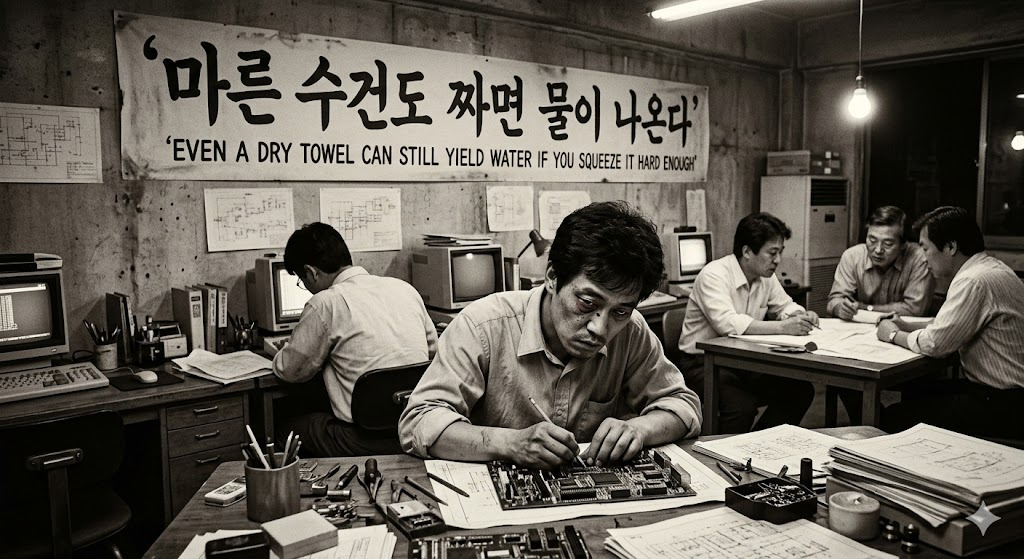
Around 1989, during my years working at Samsung Electro-Mechanics, I visited a Samsung Electronics design lab in Giheung for a business meeting. What I witnessed there has stayed with me ever since. Today, Samsung stands as a global giant, but back then it was still in its brutal formative years, desperately chasing Japanese semiconductor companies while preparing for the next generation beyond 256K DRAM.
The moment I stepped into the design lab, a large phrase posted prominently on the wall immediately caught my attention:
“Even a dry towel yields water if you squeeze hard enough.”
1989, Giheung: The Ferocity of the Engineering Floor
The words sent a chill down my spine. There was something almost unsettling about them. It was not simply a slogan about pushing employees harder like wringing out a dry rag. It embodied the fierce intensity that filled those labs day and night — the heat of relentless engineering work, the exhausted, bloodshot eyes of engineers, and the raw organizational ferocity that allowed Samsung to attempt what once seemed impossible.
Extracting Limits, Not Just Efficiency
At the time, Samsung was not merely squeezing costs. It was squeezing the limits of both the organization and the people inside it. Instead of accepting reports explaining why something could not be done, teams argued and debated until they found a way forward. Once a strategy was decided, the entire organization pushed forward with overwhelming execution power. The phrase on that laboratory wall symbolized exactly that kind of institutional ferocity.
What Chairman Lee Byung-chul Saw in People
Sometimes I wonder where Chairman Lee Byung-chul found the conviction to enter the semiconductor industry in 1983, when nearly everyone believed the attempt was impossible. I doubt he was simply betting on the future market alone.
Perhaps he believed in something deeper: the extraordinary capacity of Samsung’s people to keep pushing beyond apparent limits — to squeeze water even from a dry towel. That confidence in human capability may have been the true foundation beneath Samsung’s semiconductor rise.
Quiet Headlines, but an Unanswered Question
Recently, many of the harsh headlines surrounding Samsung Electronics — from criticism over HBM leadership to concerns about widening technology gaps — seem to have quieted down somewhat. That may signal temporary stabilization. But as an investor, what concerns me is not the silence of the news cycle.
What concerns me is whether complacency has quietly replaced the sense of urgency that once defined the engineering floor.
I find myself looking beyond the technology itself. I watch for whether the desperate intensity that once flowed through those design labs in 1989 is still alive today. Systems may have grown larger, and financial metrics may recover again, but I cannot help wondering whether engineers inside the organization are now constrained by invisible internal barriers — or whether the old “dry towel” mentality has slowly transformed from voluntary obsession into mere institutional pressure.
The Atmosphere of the Floor as an Investment Indicator
Analysts who have never stood inside a factory or design lab tend to focus only on yield rates and operating margins. But after spending decades around industrial sites, I have come to believe that the real investment indicator lies elsewhere: in the bloodstream of the organization and the atmosphere on the engineering floor.
Technology can be purchased with capital. But the kind of organizational culture that once drove people to push themselves beyond their limits cannot simply be bought with money.
There is only one condition under which I would once again make a strong long-term bet on Samsung’s future: I would need to feel that same chilling sense of intensity I experienced in that design lab back in 1989 — not as forced pressure from above, but as a form of voluntary ferocity still burning inside the organization itself.
Financial statements can recover. Market share can rebound. But whether the temperature of that “voluntary ferocity” has truly returned to Samsung’s engineering culture is something I still do not know.