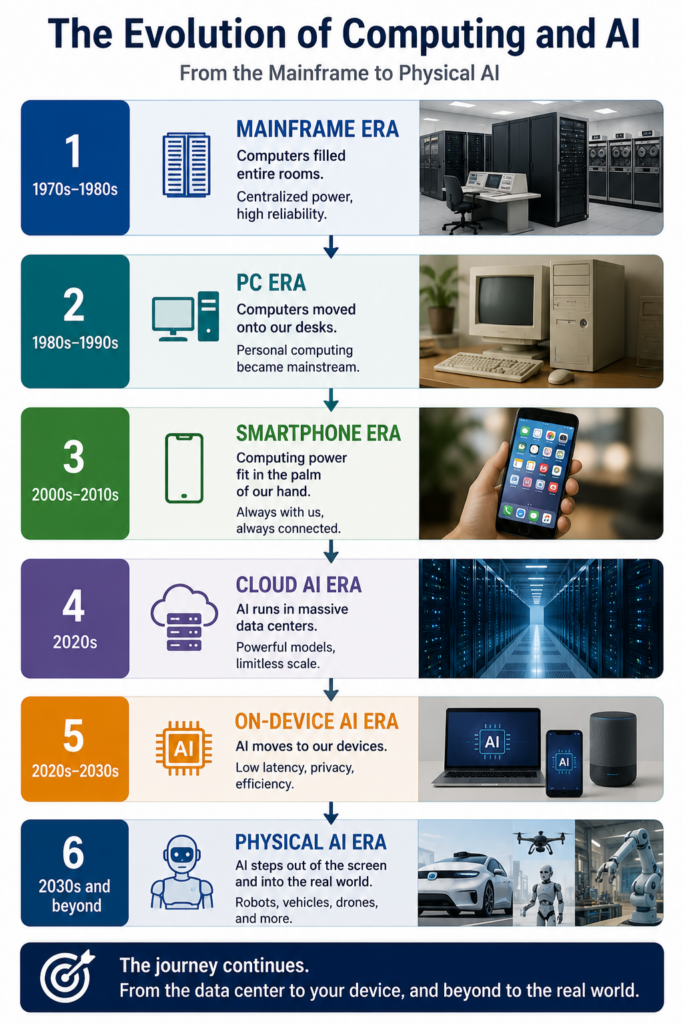
The smartphone we carry in our pocket today is really a small computer with a phone function built in.
Computers used to fill entire rooms. Then they became personal computers and came down onto our desks, and eventually into the palm of our hand. The history of computing has been a story of massive technology becoming smaller, cheaper, and more woven into everyday personal life.
AI is walking a similar path.
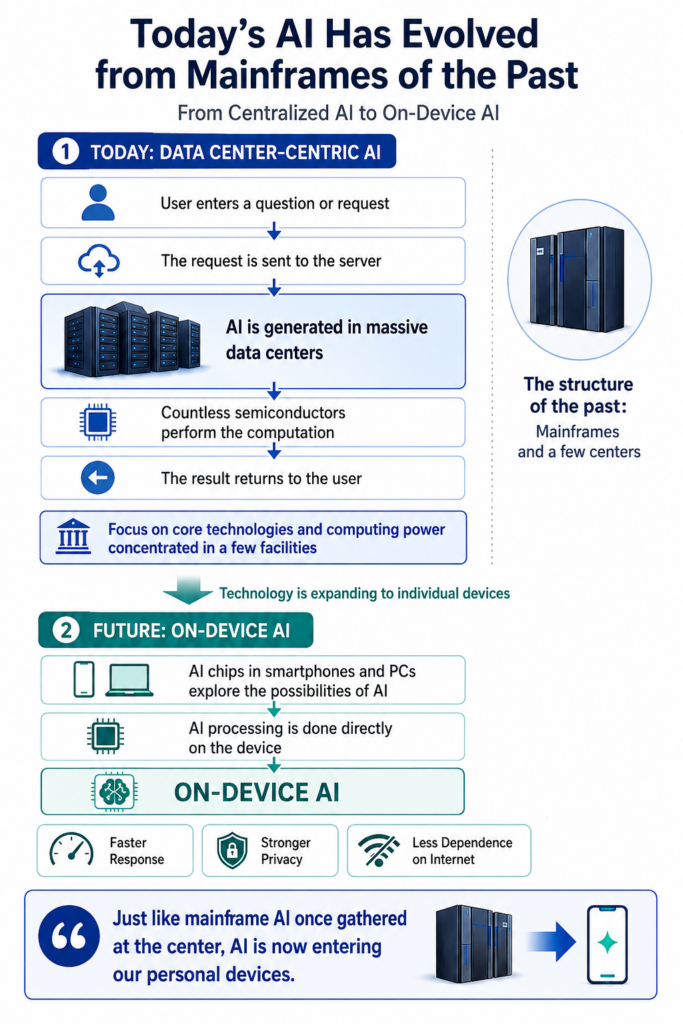
Today’s AI resembles yesterday’s mainframe
Most of today’s generative AI runs in massive data centers. A user types in a question, a server processes it, and the result comes back. In the sense that core technology and computing power are concentrated in a handful of enormous facilities, this closely resembles the mainframe era.
But AI is gradually moving into personal devices. Smartphones and PCs already carry dedicated AI chips. Going forward, more tasks will be processed directly on the device rather than being handed off to a server. This is on-device AI.
Cloud AI won’t disappear. It’s more likely that the two will develop together: large-scale computation staying with data centers, while tasks that need fast response times and data privacy move to personal devices.
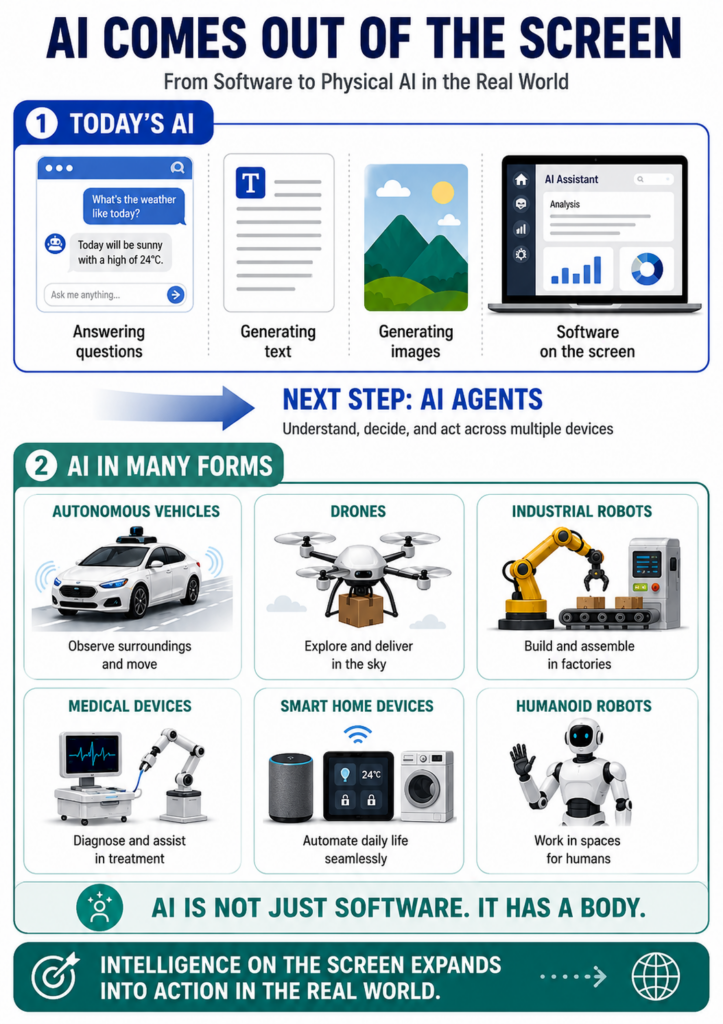
AI is stepping outside the screen
Today’s AI mostly exists as software that answers questions and generates text and images. The next stage is the AI agent: software that understands what a user needs, judges what has to be done, and operates across multiple programs and devices.
When AI merges with cars, drones, factory equipment, medical devices, home appliances, and robots, intelligence that once lived inside a screen becomes intelligence that acts in the physical world. And in this stage, AI doesn’t have just one body. Wheels become the body for a car, wings become the body for a drone, a mechanical arm becomes the body for an industrial robot. A humanoid robot is simply one of many possible forms physical AI can take — the one that happens to resemble us most.
This shift of AI stepping outside the screen and taking on different physical forms also means the competitive battlefield is expanding — from software to hardware, from the data center to the real world. The semiconductor industry has already lived through a transition like this once before.
When Technology Changes, the Rules of Competition Change with It
History rarely repeats itself exactly, but it often rhymes. Few industries illustrate this better than semiconductors, where shifts in technology have repeatedly rewritten the rules of competition.
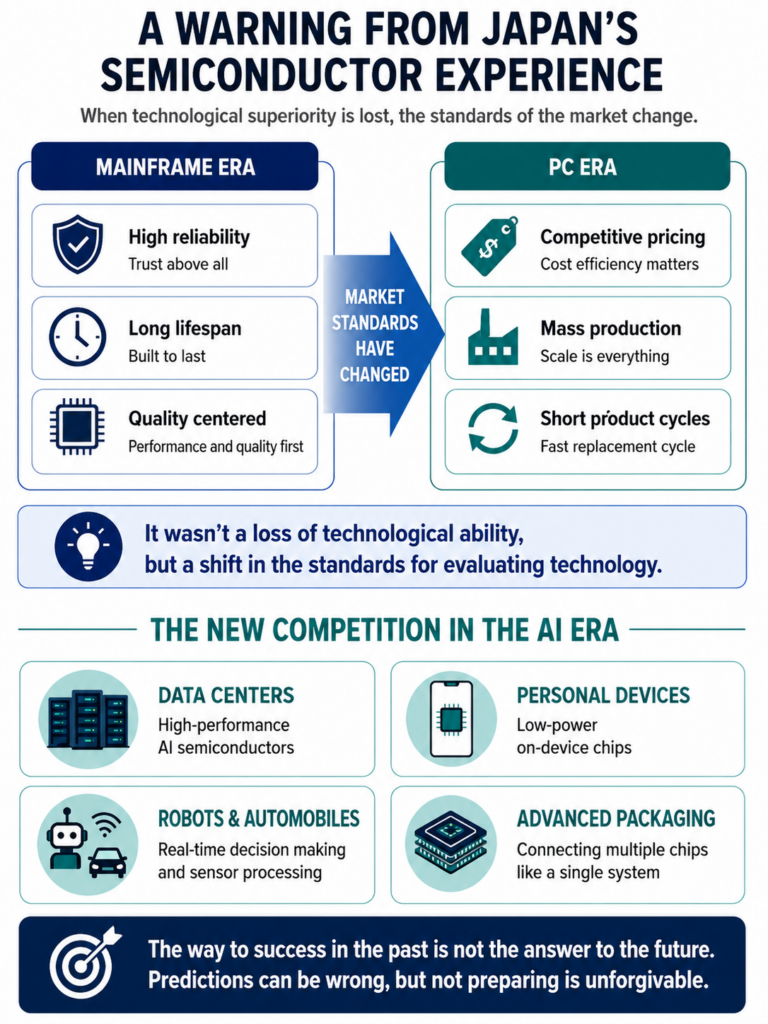
In the 1980s, Japanese semiconductor companies dominated the global market. During the mainframe era, high reliability, long product lifespans, and uncompromising quality defined competitive advantage. But as the industry shifted toward personal computers, the rules changed. Competitive pricing, mass production, and rapid product cycles became the new measures of success.
Japan’s semiconductor industry declined for many reasons—trade friction, reduced investment, and structural changes across the industry. Yet one lesson stands out: industry leaders rarely fall because they lose their technological capabilities. More often, they fall because they fail to recognize that the basis of competition has changed.
The AI-Era Battlefield Is Much Broader
As AI expands beyond data centers into personal devices, vehicles, robots, and home appliances, the chips it requires become increasingly diverse. Data centers demand ultra-high-performance processors. Personal devices need low-power, on-device AI chips. Robots and autonomous vehicles require real-time decision-making and sensor processing.
Advanced packaging—the technology that integrates multiple chips into a single, highly efficient system—will become increasingly important. The winners of the AI era will not necessarily be those who build the single most powerful chip, but those who can deliver the right chips for the right applications and integrate them into complete solutions.
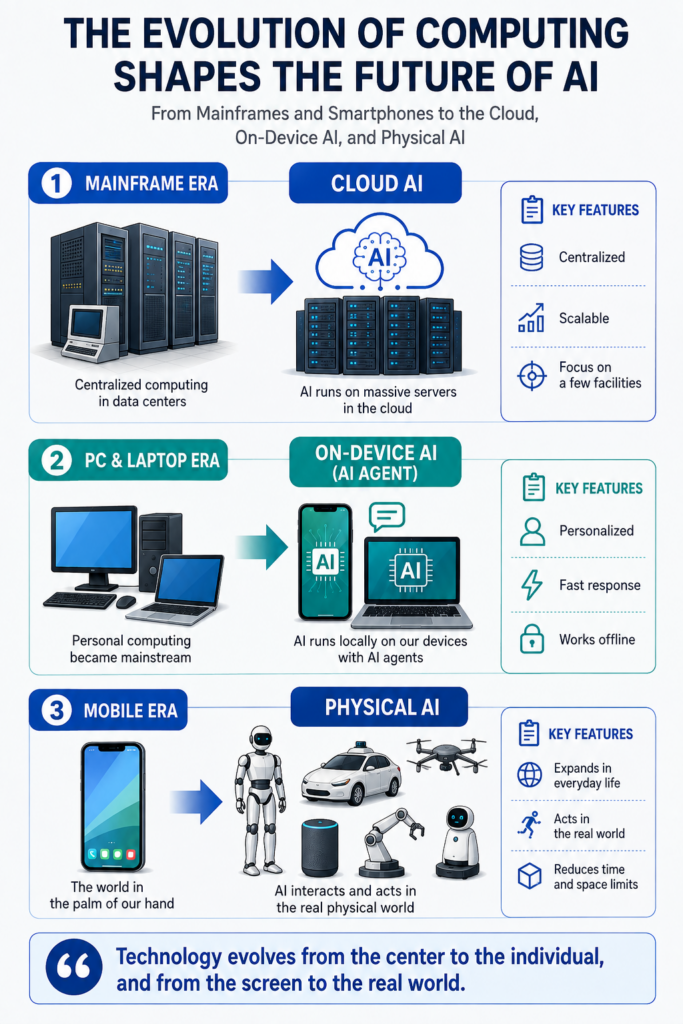
Just as computers evolved from room-sized mainframes to desktop PCs and eventually to smartphones, AI will continue its journey—from centralized data centers to personal devices, and ultimately into the physical world.
No one can predict the future with certainty. But history repeatedly reminds us that the greatest risk is not being wrong—it is adapting too late.