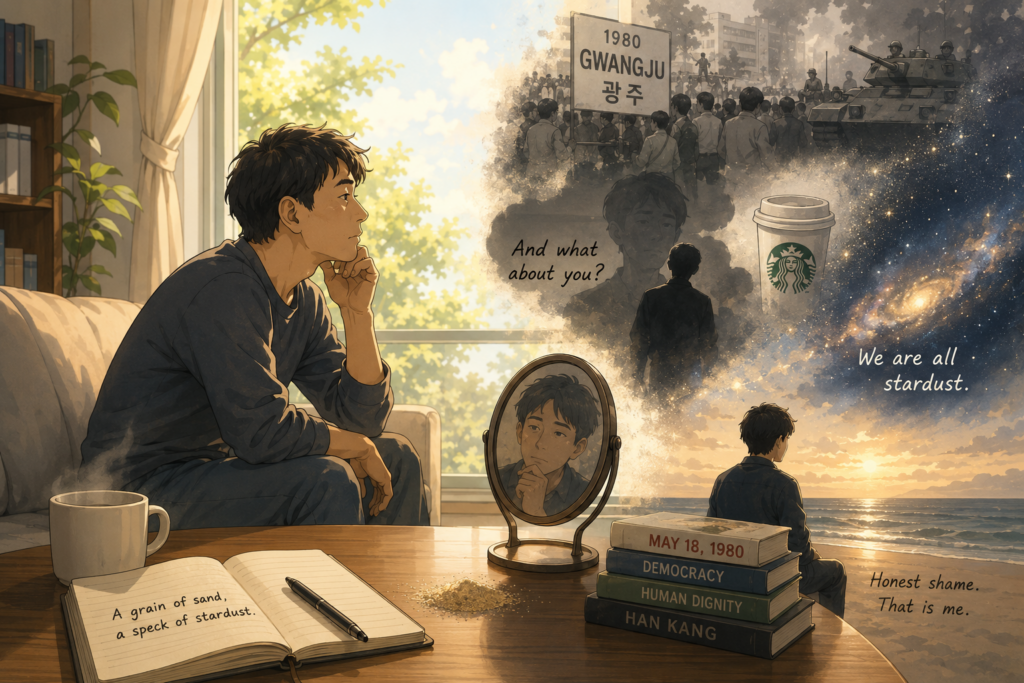
Writing with a shallow well of knowledge—scarcely more than a single grain of sand on a vast beach—I was suddenly struck by a wave of fear. It felt as though the thin piece of cloth covering me might be stripped away, leaving me stark naked. It was a deeply humbling and embarrassing thought.
On a Sunday afternoon, leaning back on the sofa and scrolling through YouTube, a video about the Gwangju Uprising of May 1980—a pivotal moment in Korea’s struggle for democracy, when innocent citizens faced brutal state violence—caught my eye. At first, I intended to watch only a few moments. Yet I found it unbearable to watch to the end, confronted by the horrific suffering of people rendered completely helpless against state force.
As someone who lived through that era, a heaviness settled in my heart. At the same time, a strange sense of self-reproach washed over me. What kind of souls were those who held fast to their convictions, fully aware that doing so might cost them their lives?
Of course, these two things cannot be weighed on the same scale. Yet not long ago, I also found myself uneasy over a public controversy involving Starbucks Korea. My discomfort came from the thought that certain expressions evoking the memory of May 18 could reopen deep wounds for many people. Whether it was indifference or simply a lack of sensitivity, it did not seem like something to dismiss lightly.
As I sat with those thoughts, a sudden question echoed from deep within me:
“And what about you?”
I caught sight of my own reflection—so quick to judge the good and evil of others based on their background and history. While criticizing the numbness that can accompany immense wealth and power, I suddenly found myself asking an uncomfortable question. Was there also a hidden longing within me to possess that same success? Was my judgment rooted purely in conviction, or was there, somewhere deep inside, an inferiority complex toward the ultra-wealthy?
Realizing how easily I passed judgment on others while placing myself on a moral high ground, I felt all the more small and pathetic.
Standing before the deep, monumental narratives brought to light by authors like Han Kang, I wondered whether there was any room for someone like me to interject. I felt so ashamed that I almost wanted to lay down my pen.
Yet a single sentence from Carl Sagan—or “Sagan,” as I like to pronounce his name—held me back:
“We are all stardust.”
In the realization that even towering mountains and the most powerful people are, in the end, nothing more than specks of cosmic dust, I found a strange sense of solace.
So what if what I know is no larger than a grain of sand?
If I know shame, and if I know how to shed a single tear before the pain of history, isn’t that enough?
I decided to stop putting on airs and simply accept this wavering, conflicted heart of mine for what it is.
Even if every scrap of cloth is stripped away and I am left bare, if what remains inside is an honest sense of shame, then perhaps that, too, is the truest essence of who I am.
Under today’s bright Sunday afternoon sun, I think I’ll gently lay out this heavy self-reproach to dry.