1. The Grueling Quest for a Small Piece of Digital Territory
Recently, while building an independent digital space of my own, I came to feel something quite deeply about the closed structure of major IT platforms. I decided to set up a self-hosted WordPress site on an overseas server, hoping to bypass the constraints and policy changes of large domestic platforms.
However, the process was far more grueling than I expected. Payment issues, foreign identity verification procedures, complex server settings, and security configurations—even carving out a small piece of digital territory for myself felt surprisingly difficult. Somewhere along the way, a frustrating thought occurred to me: If it is this hard for an individual to establish even a tiny independent space online, what kind of philosophy are these giant platform companies really built upon?
2. When Business Was Seen as Nation-Building
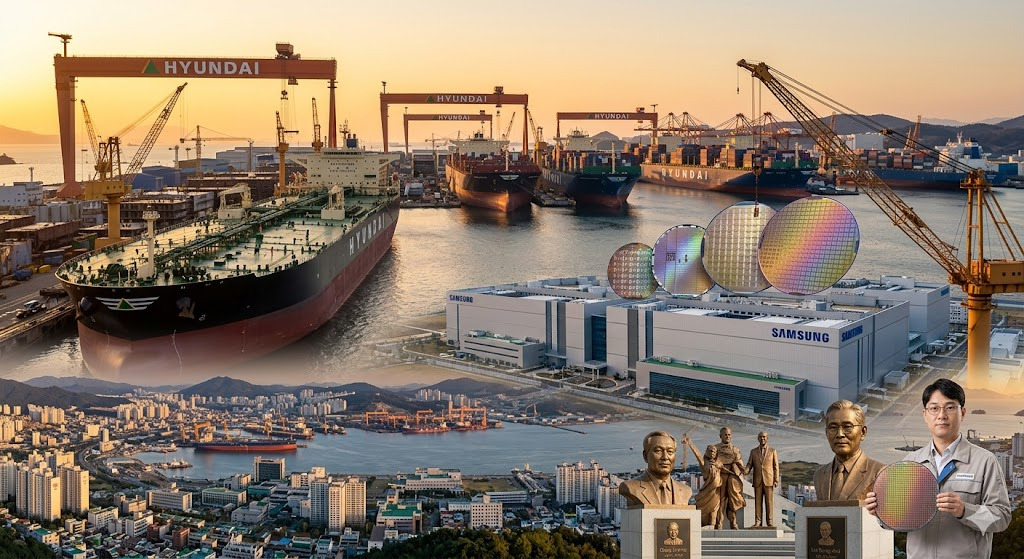
For many of South Korea’s first-generation industrial founders, business was not viewed merely as a machine for generating immediate quarterly profit. At least in their minds, corporations were instruments for building national industrial foundations and creating a future the country did not yet possess. One phrase often associated with that generation was “Contributing to the nation through entrepreneurship”
Today, the expression may sound old-fashioned or even naïve to modern tech executives. But when you look at the enormous risks taken during Korea’s industrial rise, the core idea becomes easier to understand. Figures such as Lee Byung-chul of Samsung and Chung Ju-yung of Hyundai pushed aggressively into industries that the world believed Korea could never master: semiconductors, shipbuilding, and heavy industry.
Of course, that era was far from perfect; it was marked by authoritarian politics and severe historical shadows. Still, there was at least a shared conviction that corporate growth and national development were moving in the same direction.
3. The Walled Gardens of Modern Platform Empires
Today, however, many platform giants seem fundamentally different. Rather than building long-term technological competitiveness or opening entirely new industrial frontiers, many platforms appear increasingly focused on strengthening lock-in structures—keeping users, creators, and income streams strictly dependent on the platform itself.
At first, platform ecosystems feel liberating because they are undeniably convenient. But over time, your data, your audience, and eventually your very livelihood begin to depend entirely on policies you do not control.
- One day, a recommendation algorithm changes overnight.
- Another day, advertising revenue sharing rules shift.
- A monetization policy is rewritten without prior consultation.
Suddenly, something you thought belonged to you no longer feels stable. Many digital creators eventually face the sobering reality: “What I thought was my own digital home was actually just rented space built on someone else’s proprietary land.”
4. Reclaiming Digital Self-Sovereignty
This realization is precisely why I chose to build an independent, WordPress-based space despite the friction. While large platforms offer convenience and immediate reach, individuals gradually surrender complete ownership over their connection to readers and their identity as creators.
Independent infrastructure is exhausting. Setting up servers and handling security configurations can be painfully tedious, especially for those who aren’t digital natives. At times, the process is so frustrating that your eyes blur from staring at configuration screens for hours. But once the space is finally established, it carries a completely different weight. For the first time, the foundation itself belongs to you.
During the 20th-century industrial era, companies tried to escape foreign dependence by building their own factories and core technologies. Perhaps individuals in the 21st-century digital age now face a similar structural challenge. We are entering an era where people must build at least one piece of digital territory they truly control.
The industrial giants of the past built the physical foundations of modern society through sacrifice and determination. Today, perhaps ordinary individuals must strive for something smaller, yet equally vital: digital self-sovereignty. And perhaps that is where the true meaning of entrepreneurship begins once again.
What does digital independence look like for you? Have you ever felt a sense of loss or instability due to sudden algorithm or policy shifts on major platforms? I’d love to hear your thoughts and experiences in the comments below.s in the comments below.
Discussion Question: What does digital independence look like for you? Have you ever felt a sense of loss or instability due to sudden algorithm or policy shifts on major platforms? I’d love to hear your thoughts and experiences in the comments below.