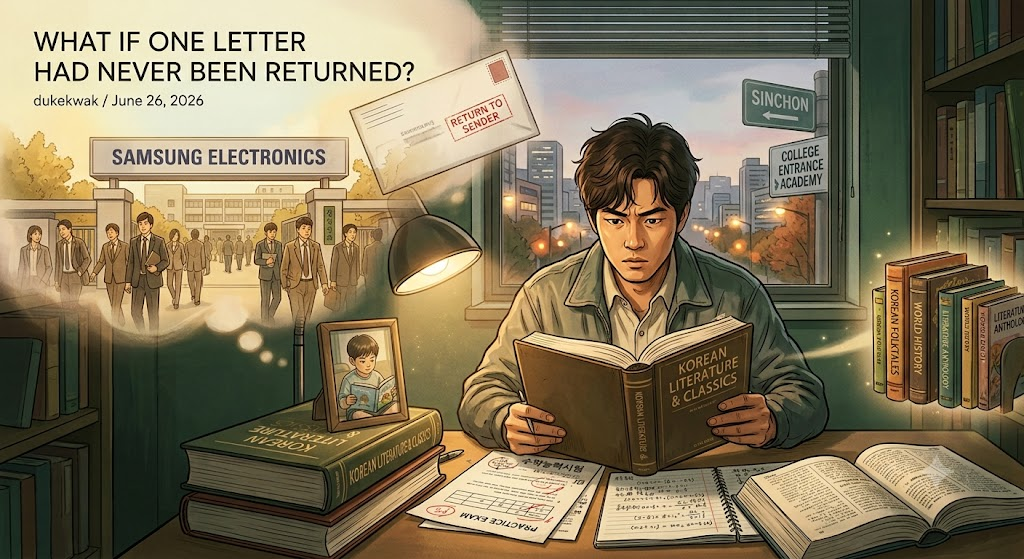
After finishing my military service, I found myself standing at one of the biggest crossroads of my life.
I applied for Samsung Electronics’ high school graduate recruitment program. I passed the written exam, and I thought I had done well in the interview.
But the acceptance letter never came.
“I guess I didn’t make it.”
So I made my decision.
I would go to college instead.
I spent every bit of money I had saved from part-time jobs after leaving the military and enrolled in a college entrance exam academy in Sinchon. It felt like my last chance.
The very next day, the phone rang.
“Congratulations. You’ve been accepted. Please report to the main gate of Samsung Electronics in Suwon on August 1.”
Only later did I discover what had happened.
My acceptance letter had been mailed to the wrong address and returned to the company.
I remember sitting there with the phone still in my hand, unable to put it down.
Back then, Samsung Electronics was one of the most sought-after companies in Korea, and my family’s financial situation was far from comfortable.
It wasn’t an easy decision.
After several days of thinking, I chose to continue down the path I had already started.
At the time, I had no idea that one decision would change the direction of my life.
August 1, 1983.
There were only three months and twenty days left before Korea’s national college entrance exam.
Most students had been preparing for years.
I was just getting started.
Time was my greatest disadvantage, so I needed a strategy.
I devoted half of my study time to English and mathematics. The rest went to Korean language and memorization-heavy subjects.
There was only one thing I truly trusted.
My ability to concentrate.
Every morning, I woke up at 4:30.
I attended the first class at the academy, then headed straight to the public library. I stayed there until closing time, went home, slept, and woke up at 4:30 the next morning to do it all over again.
That became my routine until the day of the exam.
Korean had always been my strongest subject, so I saved it for later.
Then one practice exam shocked me.
I got only about half the questions right.
Oddly enough, doing poorly in the subject I was most confident about hit me harder than struggling in any other subject.
From that day on, I devoted much more time to Korean literature and classical texts.
When the entrance exam was over, the results surprised even me.
The two subjects I had invested the most time in—English and mathematics—improved less than I had hoped.
But I missed only one question in Korean, and only one or two in history and social studies.
The results were better than I had ever expected.
It took me many years to understand why.
As a child, I simply loved reading.
I read anything I could find and often lost track of time.
Without realizing it, reading taught me how to understand context, and long periods of concentration became second nature.
Perhaps that was the real reason.
Exam passages felt like stories instead of problems.
Facts connected naturally instead of feeling like isolated pieces to memorize.
Years of reading had quietly built a level of concentration that made a few intense months of studying far more effective than I had imagined.
After receiving my exam results, I seriously considered becoming a teacher.
In the end, I followed my uncle’s practical advice and chose a different university.
Even now, I occasionally find myself thinking about that summer.
What if the acceptance letter had reached my mailbox?
Would I have spent my entire career at Samsung?
Would my life have turned out completely differently?
I’ll never know.
I do believe that reading—and the concentration it quietly nurtured—helped me walk the path I eventually chose.
But whether that path was truly my own choice, or simply the result of one letter being returned to the sender…
I still don’t know.